 Jeevan Kumar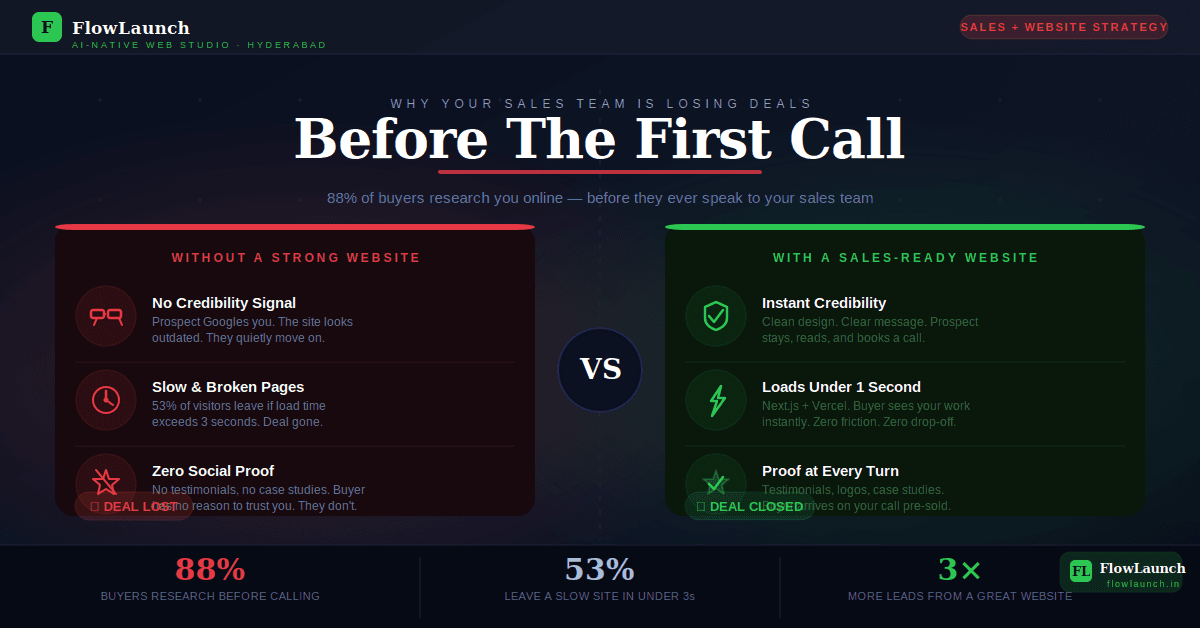
Imagine this.
Your salesperson just had a great intro call. The prospect seemed interested. They exchanged numbers. The call ended on a high note.
Then... silence.
No reply. No follow-up from the prospect. Nothing.
What happened?
Here is what most sales leaders never find out: the prospect Googled your company after the call, landed on your website, and quietly moved on.
No dramatic rejection. No feedback. Just gone.
This is happening every single day to thousands of businesses — and the sales team gets the blame for "not closing well" when the real problem is something they had zero control over: the website.
The Shocking Truth About How Buyers Behave in 2026
Let us start with some numbers that should make every sales leader sit up straight.
88% of B2B buyers research a company online before they take a sales call.
That means nearly 9 out of 10 of your prospects have already formed an opinion about your business before your salesperson says "hello."
They have looked at your homepage. They have tried to find your pricing. They have looked for client testimonials. They have read your About page.
And if any of those things looked bad, outdated, confusing, or just... off — they may have already decided the answer is "no" before the conversation even begins.
Here is another number: 80% of sales require at least 5 follow-ups, yet 44% of salespeople give up after just one attempt. But here is the thing — if the prospect had a bad website experience, even the most persistent salesperson cannot bring them back. You cannot follow up your way out of a trust problem.
The website is the silent deal-killer sitting right at the top of your sales funnel.
What Buyers Are Actually Doing When They "Do Their Research"
When a buyer says they want to "look into your company," here is what they are actually doing:
1. They check if you look legitimate. Is this a real company? Does it look professional? Does the design feel modern or does it look like it was built in 2011? First impressions happen in less than a second. Research from Google shows people form a visual opinion of a website in under 50 milliseconds. That is faster than a blink.
2. They look for proof that you have done this before. They want case studies. Client logos. Testimonials. Real results. If your website has none of these — or they are buried deep in a page no one can find — the buyer starts to wonder: "Have they actually done this for someone like me?"
3. They try to understand what you actually do. This sounds obvious, but most business websites fail at this completely. They use vague industry jargon. They say things like "We deliver end-to-end solutions that drive business value." The buyer reads that and thinks: "What does that even mean?"
4. They try to figure out if they can afford you. Buyers do not want to waste time on a sales call only to find out the price is way out of budget. If your website gives absolutely no pricing signals, some buyers will just move on to a competitor who does.
5. They look for easy ways to reach you. If your contact page has a broken form, a dead email address, or asks for too much information — you lose them. Friction kills momentum.
Now think about your own website. Does it pass all five of these checks?
The Real Cost of a Bad Website (In Sales Terms)
Let us make this concrete with real math.
Say your sales team gets 100 leads per month. Your close rate is 20%, so you close 20 deals.
Now say 30% of those leads — 30 people — quietly drop off after checking your website and finding it unconvincing.
Without the website problem, you would have had 130 leads. At a 20% close rate, that is 26 deals.
You just lost 6 deals per month because of your website.
If your average deal is worth ₹1,50,000 — that is ₹9,00,000 per month in revenue quietly walking out the door. Every month. Without your sales team ever knowing why.
A well-built website does not just look nice. It is a revenue tool that runs 24/7 and works before your sales team is even awake.
The 5 Website Problems That Kill Sales Deals
Here are the most common website issues that destroy sales trust — and most business owners do not even know they have them.
Problem 1: The Homepage Explains Nothing
Your homepage has about 5 seconds to answer three questions:
- What do you do?
- Who do you do it for?
- Why should I trust you?
If a visitor has to scroll, click, and dig to find those answers — they will not. They will leave.
Most business websites open with a dramatic headline like "Transforming Businesses Through Innovation" — which says absolutely nothing. Replace that with something specific: "We build fast, modern websites for growing businesses in India — in 14 days."
Clear beats clever. Every time.
Problem 2: No Social Proof
Buyers do not trust what you say about yourself. They trust what other people say about you.
If your website has no testimonials, no client logos, no case studies, no star ratings — you are asking buyers to take a leap of faith. Most will not.
Even 3–4 short testimonials with real names and company names can dramatically increase how trustworthy your website feels.
Problem 3: The Website Looks Old or Broken on Mobile
More than 60% of web browsing now happens on mobile phones. If your website looks cramped, buttons are hard to tap, or text is too small to read on a phone — you are losing a huge chunk of your potential buyers before they even get to your pitch.
A broken mobile experience signals: "This company does not care about details." And if they do not care about details on their own website, why would they care about details on my project?
Problem 4: No Clear Next Step
Every page of your website should tell the visitor what to do next. Book a call. Request a quote. See our work. Read this case study.
If your website just... ends — with no clear action for the visitor to take — they will close the tab and move on.
The best websites guide visitors through a journey. They do not just give information. They create momentum.
Problem 5: Slow Loading Speed
Google data shows that if a website takes more than 3 seconds to load, more than half of visitors will leave before it even finishes loading.
Slow websites do not just frustrate users. They also rank lower on Google, meaning fewer people find you in the first place.
Speed is not a nice-to-have. In 2026, it is a baseline expectation.
Why AI Has Made This Problem Worse (Not Better)
Here is the part most people are not talking about.
As AI tools have gotten better at automating outreach — emails, LinkedIn messages, cold calls — buyers are now receiving more sales messages than ever before. The volume of outreach has exploded.
What has changed is how buyers respond to that volume.
They have gotten better at filtering. They check your website faster. They make decisions quicker. And their standards for what "looks trustworthy" have gone up — because they have seen thousands of polished, well-designed websites from your competitors.
Research from 2026 shows that AI is handling more and more routine sales interactions — scheduling, initial outreach, follow-ups. That means when a human salesperson finally gets on a call, the buyer expects it to matter. They want to feel like they are talking to someone credible, from a credible company.
Your website is the proof of credibility that makes your salesperson's job easier — or harder.
What a Sales-Optimised Website Actually Looks Like
A website that works for your sales team is not just pretty. It does specific things.
It answers the buyer's questions before they ask them. Instead of vague headlines, it has specific copy: who you serve, what you build, how long it takes, what results you get.
It shows real work. Portfolio pages with actual client projects, not just screenshots. Case studies that explain the problem, the solution, and the result. The more specific, the better.
It removes friction from the next step. A simple, fast-loading contact form. A direct WhatsApp link. A calendar booking tool. Multiple ways to reach you so the buyer can choose what feels easiest.
It loads fast — on every device. Optimized images. Clean code. No unnecessary plugins. Performance-first development means buyers never wait for your page to load.
It builds trust before the first conversation. Testimonials, client logos, awards, certifications, news mentions — any third-party validation that says "other people have trusted this company and it worked out."
When your website does all of this, something interesting happens: your sales team finds it easier to close deals. Prospects arrive on calls already warm. Already half-convinced. The website did the pre-selling — and now the salesperson can focus on understanding the client's specific needs rather than proving they are legitimate.
A Real Example: What Changes When the Website Changes
One of our clients at FlowLaunch — a B2B services company — was struggling with a familiar problem. They had a great product and a strong sales team. But their website was old, slow, and vague. Prospects would go quiet after the first call.
We rebuilt their website with a clear homepage message, a portfolio section showcasing real results, fast loading speed, and a simple booking form.
Within 60 days:
- Their proposal acceptance rate improved significantly
- Prospects were arriving on calls already familiar with their work
- The sales team spent less time "convincing" and more time understanding client needs
The sales team did not change. The product did not change. The website changed — and deals started closing.
How to Know If Your Website Is Hurting Your Sales
Ask yourself these questions honestly:
- Can a stranger understand what your business does within 5 seconds of landing on your homepage?
- Does your website have at least 3 specific client testimonials with names and companies?
- Does your website load in under 3 seconds on a mobile phone?
- Does every page have a clear call-to-action telling visitors what to do next?
- Do you have a portfolio or case studies section showing real work you have done?
- Is your contact information easy to find — on every page?
- Have you checked your website on a mobile phone recently?
If you answered "no" to two or more of these — your website is quietly costing your sales team deals. Every single day.
The Bottom Line for Sales Teams and Business Owners
Your sales team can be world-class. They can follow up perfectly, ask great questions, and handle objections brilliantly. But if the website behind them signals "do not trust us" — there is only so much they can do.
The website is not just a marketing asset. It is an active part of your sales process.
In 2026, buyers are faster, more skeptical, and more digitally savvy than ever. They do their homework before they talk to you. That homework happens on your website.
The question is: what are they finding?
Ready to Fix the Silent Deal-Killer in Your Business?
At FlowLaunch, we build fast, modern, sales-ready websites for startups, service businesses, and growing teams across India — in as little as 14 days.
We do not just make websites that look good. We build websites that work as a sales tool — clear messaging, real proof, zero friction, fast loading.
If your website is costing your sales team deals, let us fix it.
👉 Book a free 30-minute website audit with our team at flowlaunch.in
No pressure. No jargon. Just an honest look at what your website is doing for — or against — your sales pipeline.
Your sales team is working hard. Make sure your website is working just as hard.
FlowLaunch is an AI-native web development studio based at T-Hub, Hyderabad. We build websites, web apps, and MVPs for startups and growing businesses across India — fast, clean, and built to convert.